Are you interested in a specific offer or one of our products? Would you like advice?
We are here for you.
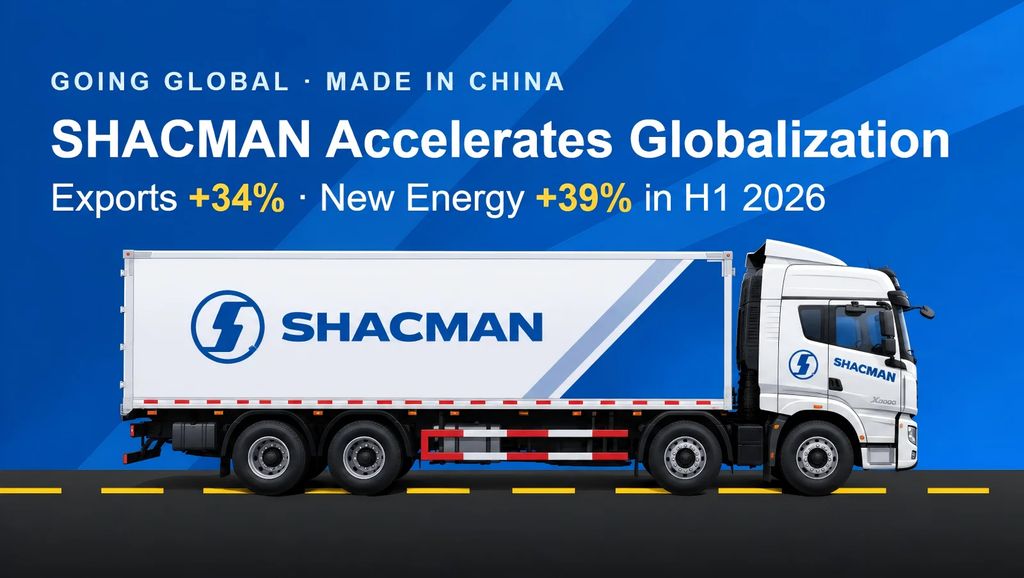
SHACMAN is accelerating its global expansion in 2026 as demand for Chinese heavy-duty trucks continues to grow across Africa, Southeast Asia, Latin America and other international markets.
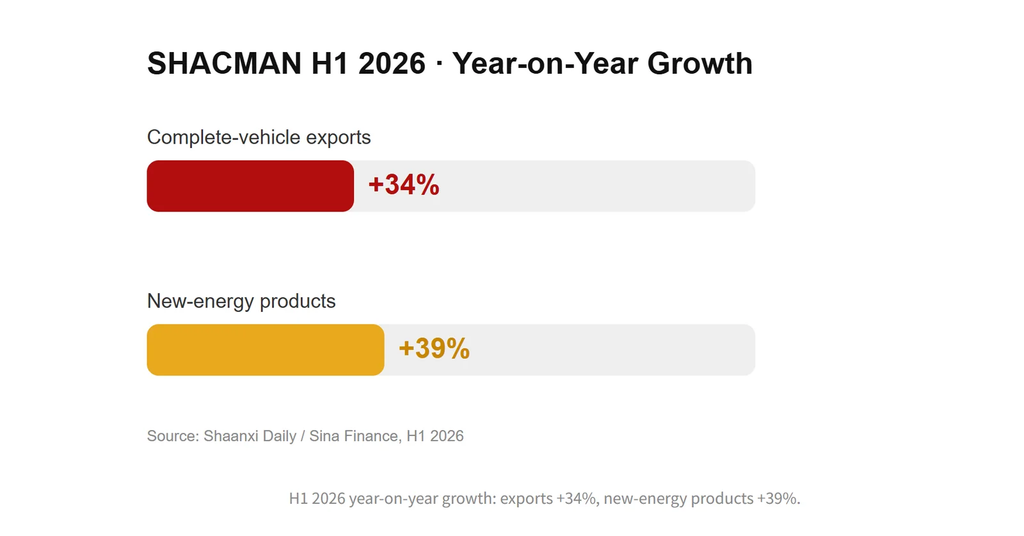
During the first half of 2026, Shaanxi Auto reported strong growth in both vehicle exports and new-energy products. Complete-vehicle exports increased by 34% year on year, while new-energy products increased by 39%, reflecting the company’s broader shift from traditional truck exports toward a more diversified global transport strategy.
The latest developments show that SHACMAN is no longer relying only on vehicle sales. Its overseas strategy increasingly combines products, dealerships, service networks, spare parts, charging infrastructure and localized operations.
International markets are becoming an increasingly important part of SHACMAN’s business.
According to public reports, Shaanxi Auto’s complete-vehicle exports increased by 34% year on year in the first half of 2026, while new-energy products grew by 39%.
This growth reflects demand from several major sectors:
For international fleet operators, SHACMAN’s expansion means a wider range of truck models, stronger local support and more market-specific configurations.
Chinese heavy-duty trucks are becoming more competitive in overseas markets because fleet buyers are increasingly focused on total cost of ownership rather than brand origin alone.
Key purchasing factors include:
SHACMAN is positioned to compete by combining heavy-duty capability with relatively flexible vehicle configuration and competitive lifecycle costs.
One of the most important developments in SHACMAN’s 2026 global strategy is its expansion in Tanzania.
A new dealership opened through cooperation between Sanxing Group and SHACMAN, accompanied by a fleet handover ceremony.
This move is strategically important because Tanzania is not only a domestic market but also a gateway to East Africa.
From Tanzania, heavy-duty truck demand can extend into surrounding markets involved in:
Exporting trucks is only the first step in building a sustainable overseas market.
For fleet customers, the most important long-term questions are:
A local dealership network reduces these risks and improves fleet confidence.
Southeast Asia remains one of SHACMAN’s most important overseas regions.
In Vietnam, SHACMAN continues expanding its product portfolio for container, cross-border and long-haul logistics.
The H3000S and other heavy-duty platforms are positioned to meet demand from logistics companies looking for stronger efficiency, reliability and driver comfort.
Southeast Asia combines multiple truck-demand scenarios:
These markets require different configurations, which makes localized vehicle engineering especially important.
Latin America is another major growth region for Chinese heavy trucks.
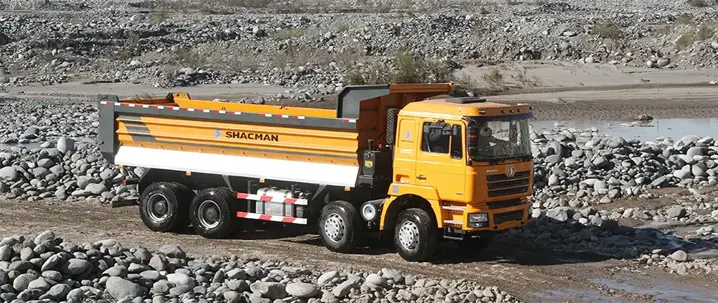
SHACMAN X3000 dump trucks have been delivered into markets such as Peru, where mining and construction create demand for durable heavy-duty vehicles.
Typical requirements include:
SHACMAN’s international strategy is increasingly linked with new-energy commercial vehicles.
The company is developing and exporting multiple technology routes, including:
Different technologies are suitable for different transport environments, and SHACMAN’s strategy is increasingly focused on matching energy types with actual operating scenarios.
SHACMAN signed an agreement with SATOMAS for 300 new-energy heavy trucks.
This type of project represents more than a vehicle order.
New-energy fleet deployment may also require:
This is why SHACMAN is increasingly positioning itself as a transport solution provider rather than only a truck manufacturer.
The establishment of the New Energy Global Ecosystem Alliance reflects a broader shift in commercial vehicle exports.
In the past, international business mainly focused on exporting complete vehicles.
Today, new-energy truck projects increasingly require an integrated ecosystem combining vehicles, infrastructure, service, software and operations.
New-energy trucks are not suitable for every route.
Battery-electric trucks are generally most effective in predictable applications such as:
Long-distance or remote applications may still require diesel, LNG or mixed-energy fleets.
A truck designed for one country may require significant changes before operating effectively in another market.
Export specifications may need to consider:
This is why SHACMAN’s international growth depends on market-specific engineering rather than one global standard configuration.
SHACMAN heavy-duty trucks commonly use established powertrain components such as Weichai engines, FAST transmissions and Hande axles.
However, the correct combination depends on the application.
Mining trucks may prioritize low-speed torque and axle strength, while long-haul tractors may prioritize fuel economy and lower engine RPM at cruising speed.
As more SHACMAN trucks enter overseas markets, demand for spare parts and after-sales support will also increase.
Common fleet requirements include:
A truck can be reliable and still lose revenue if the correct spare part is unavailable.
Fleet operators should therefore evaluate spare parts logistics before purchasing large quantities of vehicles.
A strong parts strategy includes:
SHACMAN competes in international markets through a combination of price, heavy-duty capability, powertrain selection and localized vehicle configuration.
European premium brands may offer strong highway efficiency and advanced driver systems, while Japanese brands often benefit from established regional service networks.
SHACMAN can be attractive to buyers who prioritize:
For international fleet operators, SHACMAN’s expansion may create several practical advantages.
However, buyers should still evaluate the local dealer network and service capability in their specific market before making a fleet purchase.
| Region | Recent Development | Main Applications |
|---|---|---|
| East Africa | Tanzania dealership expansion | Mining, construction, logistics |
| Southeast Asia | Premium and localized truck expansion | Ports, logistics, mining, cross-border freight |
| Latin America | X3000 and heavy-duty truck deliveries | Mining and construction |
| Global New Energy | 300-unit project and ecosystem development | Ports, industrial parks and green logistics |
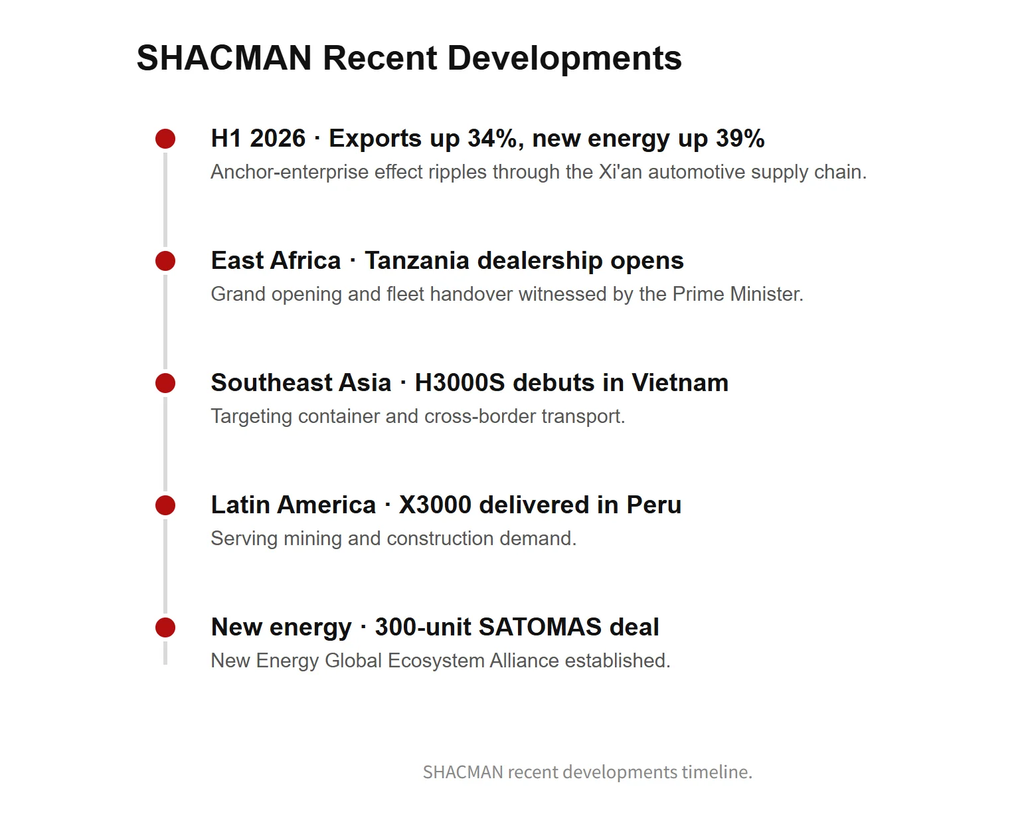
Publicly reported figures indicate that Shaanxi Auto’s complete-vehicle exports increased by 34% year on year in the first half of 2026.
New-energy products increased by 39% year on year during the first half of 2026 according to publicly reported figures.
Important regions include Africa, Southeast Asia, Central Asia, Latin America and other markets with strong mining, construction and logistics demand.
Yes. SHACMAN has developed battery-electric, battery-swap and other new-energy heavy-duty vehicle platforms for suitable applications.
Tanzania is an important domestic heavy truck market and also a regional gateway to East Africa, where mining, construction and logistics create significant commercial vehicle demand.
Local service and spare parts availability directly affect vehicle uptime, maintenance cost and long-term fleet profitability.
SHACMAN’s international portfolio includes tractor trucks, dump trucks, cargo trucks, special-purpose vehicles and new-energy heavy trucks.
For SHACMAN tractor trucks, dump trucks, new-energy vehicles and heavy-duty spare parts for international markets, contact our global truck supply team.
Website: shacmantruck.shop
Alibaba:
Alibaba International Store
WhatsApp: +86 153 4928 5748
Email:
allx1@sxdcjg.cn

Copyright @2026 © 2026 Shaanxi Dechuang Jugang Trading Co., Ltd. All rights reserved.