
Are you interested in a specific offer or one of our products? Would you like advice?
We are here for you.
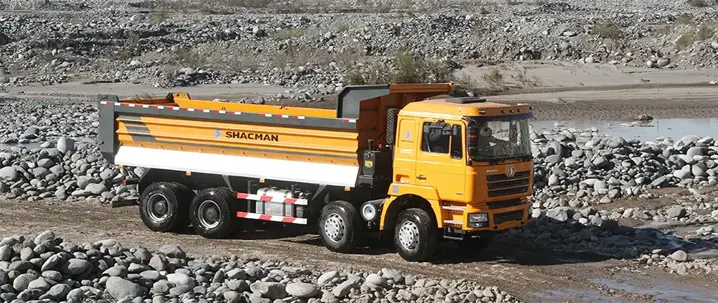
The SHACMAN X5000 8×4 mining dump truck has been upgraded for demanding quarry, aggregate, ore and heavy-duty site transport applications. The latest configuration focuses on stronger load capability, improved powertrain matching, reinforced chassis durability and higher vehicle uptime under severe operating conditions.
For mining contractors and fleet operators, a successful dump truck configuration depends on more than horsepower. Payload density, road gradient, haul distance, axle ratio, braking performance, cooling capacity, suspension strength and spare parts support all influence real transport productivity and total cost of ownership.
This guide explains where the SHACMAN X5000 8×4 mining dump truck fits, how to configure it for quarry and aggregate work, and which technical factors matter most before fleet procurement.
The X5000 mining dump truck upgrade focuses on the complete heavy-duty operating system rather than a single component.
Key areas include:
These improvements are intended to help the vehicle maintain stable performance in mines, quarries, aggregate yards and construction material transport operations.
| Application | Operating Requirement | Configuration Priority |
|---|---|---|
| Open-Pit Mining | Heavy payload and steep gradients | Torque, axle strength and braking |
| Quarry Transport | Frequent loading and short haul cycles | Chassis durability and suspension |
| Aggregate Haulage | Dense material and repeated tipping | Body wear resistance and payload matching |
| Sand and Gravel Transport | High cycle frequency | Fuel efficiency and dump system reliability |
| Ore Transport | High-density material | Axle load and body volume control |
| Construction Material Transport | Mixed paved and unpaved roads | Traction and road adaptability |
An 8×4 dump truck provides four axles and additional load distribution compared with a 6×4 configuration.
For high-density materials such as ore, aggregate and rock, this can improve axle load distribution and vehicle stability when correctly configured.
However, more axles do not automatically mean unlimited payload. Legal axle limits, tire capacity, frame strength, road conditions and dump body design must all be considered.
One of the most common mistakes in mining truck selection is focusing only on dump body volume.
Material density determines how quickly the truck reaches its allowable payload.
For example, a body designed for lower-density sand may be too large for dense ore if the operator fills it completely.
Before selecting the dump body, fleet operators should confirm:
Mining dump trucks spend much of their operating time accelerating under load, climbing gradients and working at relatively low road speeds.
For these conditions, usable low-speed torque is often more important than maximum horsepower.
A suitable engine should provide strong torque across the working RPM range while maintaining stable cooling performance during long loaded climbs.
Transmission gearing should be selected according to gross vehicle weight, road gradient and operating speed.
A mining truck requires sufficient low gears for loaded starts and steep climbs, while the upper gears should still allow efficient empty return travel.
Incorrect transmission matching can lead to excessive clutch wear, frequent shifting, higher fuel consumption and reduced productivity.
Axle ratio directly affects wheel torque and engine speed.
A higher final-drive ratio generally improves climbing ability and low-speed pulling force, making it useful in severe mine roads.
However, a ratio that is too high may increase engine RPM and fuel consumption during faster road sections.
The correct ratio should therefore be selected according to the full haul cycle rather than one section of the route.
Mining operations place significant stress on the drive axle because trucks repeatedly start under high load and operate over uneven surfaces.
Heavy-duty axle configurations should be selected according to:
For severe applications, hub-reduction axle designs can provide additional torque multiplication at the wheel end and improve drivetrain durability.
Quarry and mining roads generate continuous shock loads through the chassis.
A reinforced frame, suitable cross-members and heavy-duty suspension can help distribute these loads and reduce structural fatigue.
Suspension selection should also consider whether the truck will operate mainly on rough mine roads or mixed mine-and-highway routes.
The dump body is one of the most heavily stressed components on a mining truck.
Repeated impact from large rocks and abrasive aggregate can accelerate wear on the floor and side walls.
Dump body design should consider:
A correctly sized high-strength body can improve durability without adding unnecessary dead weight.
Mining dump trucks may complete many tipping cycles each day.
The hydraulic system should therefore be inspected regularly for:
A hydraulic failure can stop the truck even when the powertrain remains fully functional.
Loaded climbing at low vehicle speed creates high engine heat while reducing natural airflow through the radiator.
This makes cooling performance especially important in mining operations.
Fleet operators should regularly inspect:
Dust accumulation around the radiator can reduce cooling efficiency and increase the risk of overheating.
Fine mining and quarry dust can cause severe engine wear if it enters the intake system.
Air filters should be inspected more frequently than on normal highway trucks.
In severe dust conditions, maintenance intervals should be based on actual filter loading and operating hours rather than mileage alone.
A fully loaded 8×4 dump truck carries significant kinetic energy on downhill sections.
Continuous use of the service brakes can increase brake temperature and reduce braking performance.
Fleet specifications should therefore consider the complete braking strategy, including:
Tires have a major influence on traction, fuel consumption and operating cost.
Mining tires should be selected according to road surface, axle load, operating speed and heat generation.
Incorrect tire pressure can increase wear, reduce traction and increase fuel consumption.
Overloading may increase the tonnage carried on one trip, but it can also increase tire wear, suspension damage, brake stress and drivetrain failures.
For many fleet operators, a slightly lower payload with higher vehicle availability can produce better monthly output than an overloaded truck that frequently breaks down.
The most useful productivity indicator is therefore not payload per trip alone, but total tons transported over a full operating period.
Useful fleet performance indicators include:
These metrics give fleet managers a clearer picture of real vehicle efficiency.
The purchase price of the truck represents only part of its operating cost.
A complete TCO calculation should include:
In mining operations, downtime can become one of the largest hidden costs because a stopped truck directly reduces material movement.
Mining trucks should not be maintained only according to kilometers traveled.
A vehicle may travel relatively short distances while operating many hours under full load.
Maintenance planning should therefore consider both mileage and engine operating hours.
Important inspection points include:
Mining projects often operate far from major parts distribution centers.
Keeping critical spare parts close to the site can significantly reduce downtime.
Recommended inventory may include:
Before ordering a truck, buyers should provide detailed operating information.
These details help determine the correct powertrain, axle ratio, suspension, tire and dump body specification.
The X5000 8×4 mining dump truck can be used beyond conventional open-pit mining.
Quarries, aggregate plants, sand and gravel operations and large infrastructure projects also require vehicles capable of carrying dense material repeatedly over demanding routes.
The correct specification should be adapted to each site rather than using one universal configuration.
SHACMAN heavy-duty dump trucks are used in multiple overseas markets for ore, aggregate, quarry and construction transport.
Different regions can require different cooling systems, steering configurations, tire specifications, emission standards and powertrain settings.
For this reason, export vehicles should be configured according to local climate, road conditions and regulatory requirements.
It is suitable for applications such as mining, quarry transport, aggregate haulage, ore movement, sand and gravel transport and heavy construction material delivery.
An 8×4 configuration can improve load distribution and stability for heavy payload applications when axle loads and body size are correctly matched.
No. Engine power should be matched with transmission gearing, axle ratio, gross vehicle weight and route gradient. Correct powertrain matching is more important than horsepower alone.
The correct axle ratio depends on road gradient, vehicle weight and operating speed. Higher ratios generally improve pulling force, while lower ratios can improve efficiency on faster routes.
Maintenance should consider both mileage and operating hours because mining trucks may work long hours while covering relatively short distances.
Common critical parts include filters, cooling system components, brake parts, transmission parts, axle components, suspension parts, hydraulic seals and electrical sensors.
TCO can be reduced through correct vehicle configuration, controlled payload, preventive maintenance, tire management, local spare parts stock and reduced unplanned downtime.
For SHACMAN X5000 mining dump trucks, quarry transport configurations and heavy-duty spare parts, contact our international supply team.
Website: shacmantruck.shop
Alibaba:
Alibaba International Store
WhatsApp: +86 153 4928 5748
Email:
allx1@sxdcjg.cn

Copyright @2026 © 2026 Shaanxi Dechuang Jugang Trading Co., Ltd. All rights reserved.